- HubPages»
- Education and Science»
- History & Archaeology»
- History of the Modern Era»
- Twentieth Century History
World at War: German Infantry Weapons of World War II

German Infantry Weapons of WWII
Books about the German Army

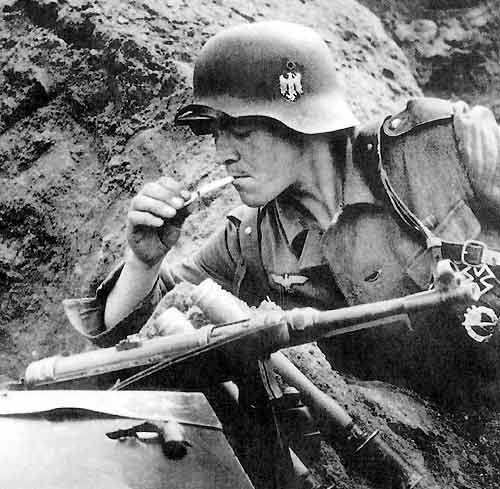
The German Infantry
The quality and economy of German equipment was as an important a factor to American success in World War II, as the quality and economy of our own. Naturally, a lot of study went into German Infantry Tactics, and especially the nature and quality of German infantry weapons. In the paragraphs below, I will give you some information about the mainstay arms of the German Army, the Heer.
While German infantry rifles may have seemed technologically outdated, their focus on machine guns as tools of attrition and maneuver made them quite effective against Russian arms. At the same time, German tanks were able to provide much needed maneuver support that helped put an end to American weapon and equipment superiority.
Walther PP
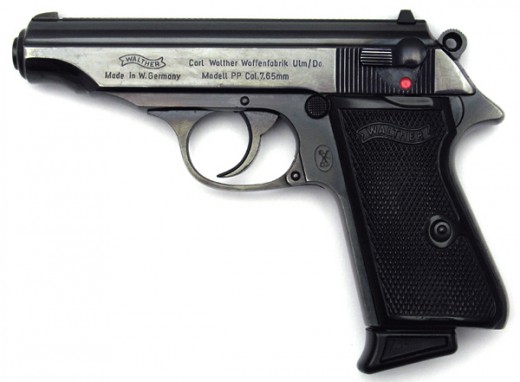
Walther PP
The Walther PP is known throughout the world, mostly for its appearance in the James Bond franchise. However, few realize that this favorite pistol of a very British (at least to Americans) super-spy got its start in the Wiemar Republic. This became the standard sidearm of German Officers, State Personalities, and special forces during the Nazi era.
The weapon uses a 7.65 mm projectile, commonly, and operates via gas pressure causing blow-back and re-chambering. It is semi-automatic, and has a comparable pistol range (roughly 100 m effective at best).
Karabiner 98k
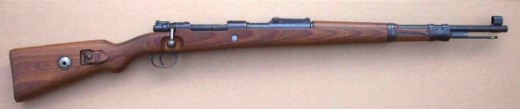
Karabiner 98k
The Karabiner served as the German Infantry Rifle for the Second World War. It was used primarily by forces of the German Army, though some limited naval use as well. The Karabiner, while reliable, was inferior technologically when compared to the M1 and other semi-automatic firearms. It could only fire one round, before it required manual action to fire the next, as opposed to semi-automatics, which fired, reloaded, and readied as one action cycle. It is possible to imagine that this decreased volume of firepower might have actually made German forces less capable in defensive roles, and especially in urban combat.
This was acceptable, though, as more resources were used to develop other arms that were essential to the success of the German Blitzkrieg. And certainly the campaigns of the early war, all the way up to the end of the German advance during Barbarossa, was testament to this.
MP40
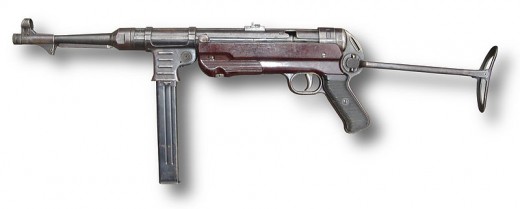
Submachine Guns
Known as 'Machine-Pistols', these weapons are between the size of a pistol and a carbine. More importantly though, they fire pistol ammunition, and are automatic. High Volumes of fire from these and german machine guns allowed for maneuverability for infantry elements during the war.
It is estimated by many that the material and ammunition needs of these weapons quickly outpaced the ability of German industry to feed them. As a result, these weapons remained mostly in the hands of NCOs and special operatives.
MG34
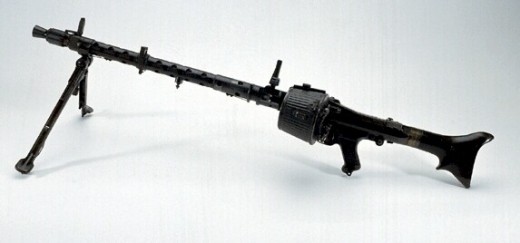
Assault Machine Gun
The MG34 was the standard Light (or 'Assault') machine gun. Meant to be carried by one soldier, including ammunition, it was capable to be transported by foot, and set up in a matter of moments, to provide suppressive fire. This allowed the weapon to be used in offensive operations, and it was a key part of the infantry role during Blitzkrieg.The weapon is gas operated, and fires a round almost 8mm at fully automatic rates. They utilize drums instead of belts, to prevent ammunition bands from getting corrupted and for easier fitting.
MG42
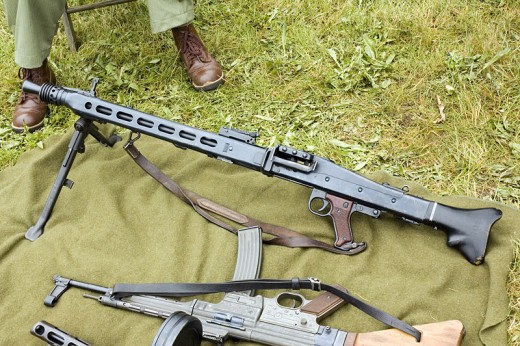
Hitler's Bonesaw
The MG 1942 (MG42) was one of the most distinctive and feared weapons of the second world war, no matter which front, or whom it was fighting. Known as Hitler's Bonesaw or the Devi's Chainsaw, the weapon featured a very high rate of fire, which coupled with its 7.92 ammunition, give it a high-pitched sound much like a chainsaw.
The weapon was recoil-operated, with gas assist, meaning that the actual momentum of the weapon's recoil was used to blow the bolt back, and chamber another round. The gas expelled from a cartridge was used to assist in this process, possibly as a redundant action, which might account for the weapons purported reliability.
In terms of Doctrine, the weapon was used primarily as a Light Machine Gun, though it broached the upper end towards a medium machine gun. This meant usually the weapon could be operated by one person, and carried by infantry, however sometimes an assistant was given to help carry ammunition, or it might be mounted on a vehicle of some sort.